"O barulho é a tortura do homem de pensamento" (Schopenhauer)

segunda-feira, 4 de março de 2013

Dress gives vibrotactile feedback to help those with hearing loss

Here is one interesting example of clothes that are more than just expensive ways to cover our nakedness. 
With the rapid advancement of mobile, flexible, and even plant-based technologies, clothing has become yet another medium upon which to explore the limits both of science and fashion. Wearable technology has really started to come into its own, with fashion designers and engineers collaborating to imagine where their fields might overlap in the not-so-distant future. While the idea of energy-generating shoes and gloves embedded with LED turn signals might sound far-fetched, the reality is that wearable technologies are already helping to make our world a cleaner, healthier place.

FLUTTER dress for the hearing impaired
For those who are partially or fully deaf, independent living can be a challenge. Hearing aids, lip reading and sign language ensure that hearing impaired are able to communicate with those around them, but being unable to hear environmental sounds can be dangerous. Finding a way to alert hearing impaired individuals to warning sounds in their surroundings would enable them to safely venture out into the world without constant supervision.


Flutter is a perfect example of the way textiles and robotics can be combined to improve the quality of life for disabled individuals. Created by Halley Profita, Nicholas Farrow, and Professor Nikolaus Correll at the University of Colorado at Boulder, the Flutter dress gives vibrotactile feedback in the direction of a loud sound or alarm to help those with hearing loss respond more intuitively to their external environment. The team also says that development of this wearable technology would also cut down on e-waste created by discarded hearing devices.

Info from Tree Huger

quinta-feira, 21 de fevereiro de 2013

How MP3 players can cause hearing loss

IPods and other portable music devices have changed the way many people listen to music. As the popularity of these devices continues to rise, hearing experts worry that the number of people with hearing loss will become as commonplace as the devices themselves.

Hearing experts are concerned that hearing loss will take place because exposure to music through these devices can be both loud and long. With the new MP3 players, such as the iPod, significant improvements in sound quality are possible in smaller and more portable devices. Sound quality, portability and convenience translate into more time spent listening to music, which makes the potential for damage even greater.

"With the older devices, like the Walkman, if you turned them up all the way, they sounded very bad, so people didn't do it. Now, they don't sound bad at maximum volume, and that could pose a problem," says Jodi Cook, Ph.D., director of the hearing aid program at Mayo Clinic, Rochester, Minn.

Although any hearing loss that occurs may not be apparent for years, once that damage occurs, it's permanent and irreversible.


How MP3 players can cause hearing loss

Music and other loud noises cause hearing loss by damaging the hair cells in the cochlea, a part of your inner ear that helps transmit sound information to your brain. These hair cells can often recover from temporary damage. If you've ever been to a rock concert and your hearing sounded muffled for the next day or two, you've experienced temporary damage to these hair cells.

But extremely loud noise, such as a gunshot, or moderately loud noise that continues for long periods of time, can permanently damage these hair cells. Once these hairs are destroyed, they don't come back and at least partial hearing loss occurs. About 30 million Americans currently have some hearing loss and approximately one-third of them have noise-induced hearing loss.

Any sound above 90 decibels (db) may cause some hearing loss if the exposure is prolonged. But most portable music players can produce sounds up to 120 db. That's louder than a lawn mower or a chain saw and equivalent to an ambulance siren.

The problem is that you don't feel hearing loss occurring. You won't know until years later that some of your hearing has been permanently destroyed.


Info from Riverside

sexta-feira, 4 de janeiro de 2013

Music is the soundtrack to our lives

Music is the soundtrack to our lives. BUT every time you listen to loud music for too long, you increase the risk of damaging your hearing.

If your exposure to loud music is repeated regularly, the damage could be permanent.
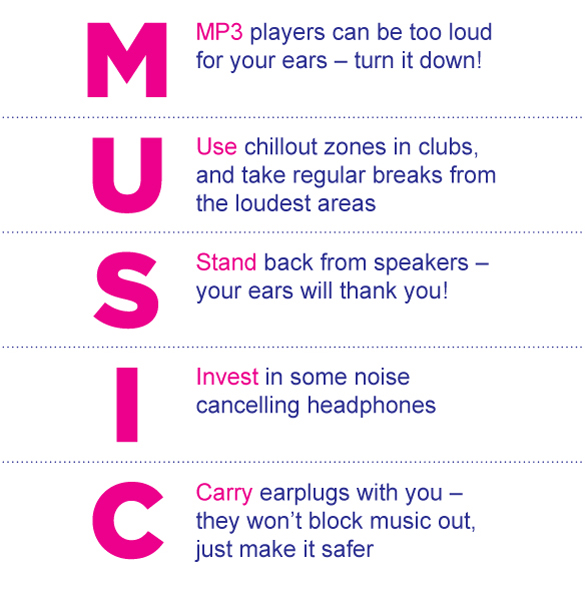
Remember - M.U.S.I.C.


sexta-feira, 28 de dezembro de 2012

Hearing Loss Travel Tips

Gael Hannan, editor from The Better Hearing Consumer , wrote an excellent article about hearing loss travel tips. The article above has been adapted from her original at Hearing Health Matters.


Does your hearing loss prevent you from traveling, worrying about potential problems on the trip? Get over it – communication problems can happen anywhere – including at home.

Everywhere you go, you take your hearing loss with you. Probably it’s your most faithful, although not favorite, travel companion, with barriers popping up at every turn – when calling a taxi, checking in to a hotel, ordering food in noisy restaurants, or talking with people whose foreign-accented lips make speechreading just a tad challenging. 


Here are a few basic travel communication strategies to kick down a lot of those barriers:

Self-identify! This is a no-brainer rule of the road that travelers ignore at their peril. If you don’t let people know you have hearing loss, you won’t get what you need, and therefore you have no right to get upset at poor or inaccessible service. Contrary to popular belief, most hearing people and tourism/hospitality people are not mind readers.

Clearly communicate your needs. (I know, I hear ya, ‘oh-duh-please-tell-me-something-I-don’t-already-know’ . But hey, this is worth repeating.) If you say, “I’m hard of hearing” and leave it at that, the hotel clerk might just think, “Well, that’s nice, thanks for sharing.” Be specific about what you need – amplification, captioning, etc. Providers sometimes call these ‘special needs’, which makes me crazy. Good communication skills, amplification and print interpretation are not ‘special’; they are fundamental needs of a huge chunk of today’s population.

Let Them Know You’re Coming! When making online bookings for hotel, air or rail, you should check off the Hard of Hearing (or Hearing Loss) box under ‘Special Needs’ (sigh). This may or may not result in better service. Sometimes “DEAF” or “HARD OF HEARING” is marked on the boarding pass, sometimes not. When it is marked, or if you verbally self-identify to the customer service person, he or she may look up you, all startled-like: “OMG, how am I supposed to talk to this deaf person?” Just smile and wait to see what they offer.

Sometimes it’s early boarding along with the babies and the infirm. I’ve heard of people receiving seat upgrades, although I’m not sure how this helps people with hearing loss, unless flight attendants speak more clearly in first class. Or they may tell you to have a seat in the lounge, and they will visually alert you when it’s your turn to board. In this case, if I have nothing else to do, or am feeling feisty, I sit close by and don’t take my eyes off them, unblinking, unrelenting, willing them to give me ‘the wave’. This might creep them out enough to get you an early boarding. Brilliant idea: airports could reduce traveler anxiety and employee stress by using signage to announce which rows are being boarded!

However you do it, your bottom line is that you have to be on that plane when it takes off. I almost missed a flight once because I’d lost track of time, wandering the airport, and didn’t hear the PA calling my name. Now I arrive at the gate well in advance.

The final word: Anticipating communication needs makes for a much smoother trip. I couldn’t prepare for being in the eye of a tropical cyclone, but emergency preparedness has come a long way since then – especially in the aftermath of Hurricane Katrina. Minor glitches like these aside, traveling is one of life’s joys, so pack your bag amd kick down some barriers.

quarta-feira, 14 de novembro de 2012

Hearing Aid - My American Girl

Thank you Mattel (who owns American Girl) for recognizing hearing loss as a condition affecting millions of children, by developing Hearing Aids to personalize My American Girl

3 in 1000 babies are born each year with permanent hearing loss, according to the American Speech Language Hearing Association, making it one of the most common birth defects in America. 


It is very important to create a greater awareness of hearing loss and helping others to have more comfort and acceptance. Helping a child with hearing loss to wear hearing devices can begin with them feeling confident. 

What a wonderful initiative!


quarta-feira, 31 de outubro de 2012

It's all gone Pete Tong - how to be a DJ with a hearing disorder

"Its All Gone Pete Tong" is a comedy based on a true story and Winner of Best Feature Film at Toronto Film Festival and Gen Art Film Festival. Paul Kaye stars as Frankie Wilde, the legendary British DJ and musical mastermind of the underground club scene whose career is cut down at its pinnacle by unthinkable tragedy - the loss of his hearing. 

The story takes us through Frankie's battle with his hearing disorder: he is rapidly going deaf with only one functioning ear to complete the new Ibiza season. Frankie dives into a low period, struggling with deafness in utter depression. After a year of locking himself away he emerges on the other side with a fresh attitude towards his affliction. He accepts his deafness and learns to function without sound. Will Frankie make it back to the DJ booth? Will his new single be any good? Will he get back his opulent old life or does he even want it back? When you can't hear, things look very different.


Info from Amazon and IMDb

sábado, 29 de setembro de 2012

O que é o zumbido?

Ruídos de apito, panela de pressão e insetos, como a abelha, o gafanhoto e o mosquito, estão entre os barulhos descritos por pessoas que sofrem com zumbido no ouvido. No silêncio, o ruído, originado dentro do corpo e percebido na cabeça ou nos ouvidos, fica ainda mais ‘alto’. "Na realidade, mesmo quando não existe modulação de volume do zumbido, o que muda é a percepção do paciente. Ou seja, quanto mais ele dá atenção ao ruído, principalmente em situações de stress e ambientes silenciosos, maior é a sua percepção", explica a otorrinolaringologista Rita de Cássia Cassou Guimarães.


O sintoma é causado por mais de 200 fatores e afeta pelo menos 278 milhões de pessoas em todo o mundo, segundo a Organização Mundial de Saúdes. 

Os idosos são os mais afetados pelo problema. "A perda de audição é a principal causa de zumbido. A deficiência auditiva, nos seus mais variados níveis, é provocada especialmente pela exposição a ruídos intensos e pelo envelhecimento. Por isso, é a terceira idade é a fase em que o zumbido mais se manifesta", destaca.

O ‘tinnitus’, como é chamado em inglês, persiste durante o dia e a noite e afeta de maneiras diferentes a qualidade de vida dos pacientes. Cerca de 15% das pessoas com zumbido sentem algum incómodo por causa do sintoma e 5% têm a sua vida profissional e social comprometida. 

"Qualquer tipo de zumbido pode ser tratado. O paciente deve procurar um otorrinolaringologista para dar início à investigação que irá determinar as causas do sintoma. Em muitos casos é necessária a intervenção de outros profissionais, o que chamamos de equipe interdisciplinar", afirma a médica, especialista em otoneurologia.


Informação acedida aqui